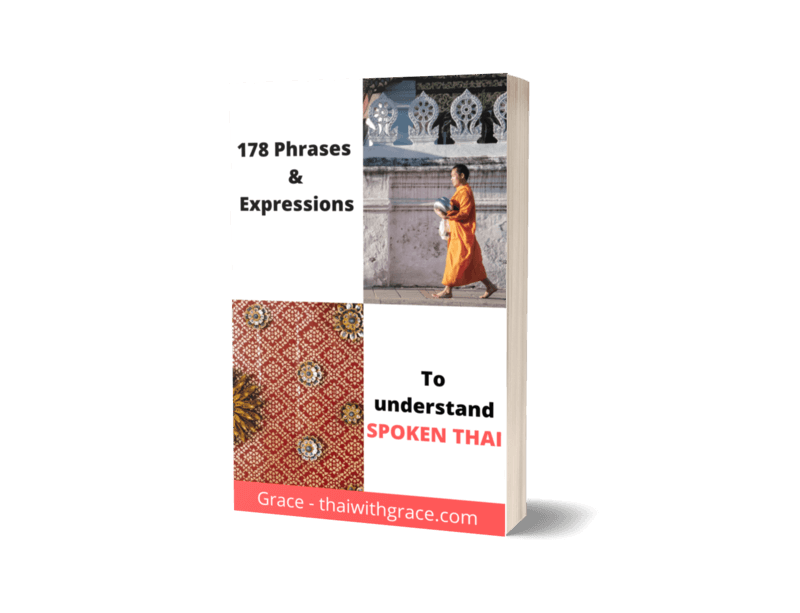
Thailand is a Buddhist country and Buddhism is ingrained in our culture in many ways. Festivals, holidays, architecture, books, and even in the language.
Thai people use different words when talking about monks. In Thai, monks are พระสงค์ (prá sŏng). For short, we just say พระ (prá).
Very well-respected monks that are grandfather’s age we call หลวงปู่ (lŭang bpòo) or หลวงตา (lŭang taa).
Monks that are well-respected that are father’s age we call หลวงพ่อ or หลวงลุง (lŭang pôr or lŭang lung).
Also, a very important thing to note is that the classifier for humans is คน (kon), but for monks, we use องค์ (ong)
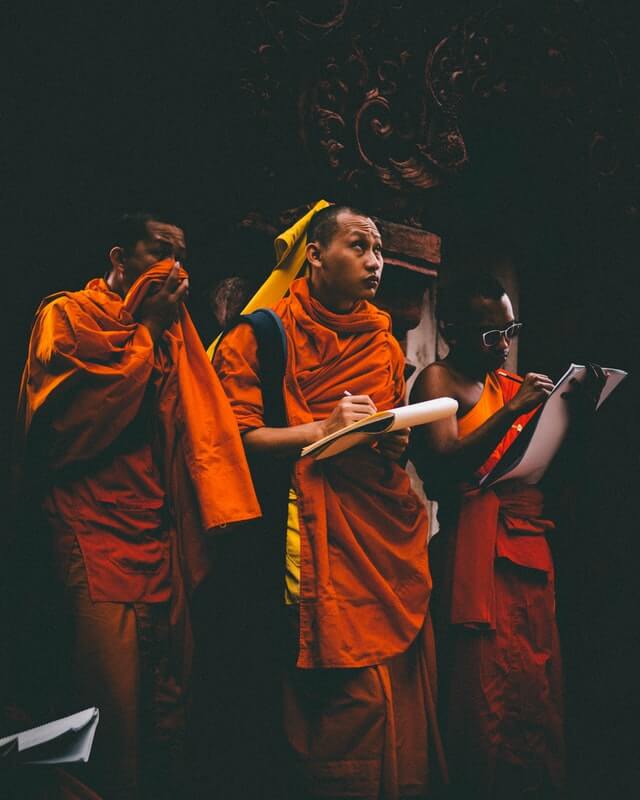
Monk Specific Verbs
Here are verbs that we use when talking about monks.
| คำกริยา | Verbs |
|---|---|
| ฉัน (chăn) | to eat |
| ฉันยา (chăn yaa) | to take a medicine |
| จำวัด (jam wát) | to sleep |
| ทำวัตร (tam wát) | to pray |
| ครองจีวร, ห่มจีวร (krong jee-won, hòm jee-won | to get dressed |
| นมัสการ (ná-mát-gaan) | to pay respect |
| นิมนต์ (นิมนต์) | to invite |
| ปลงผม (bplong pŏm) | to shave the head |
| มรณภาพ (mor-rá-ná-pâap) | to die |
| สรงน้ำ (sŏng náam) | to take a shower |
| ประเคน (bprà-kayn) | to give |
Example Sentences:
- I will (invite) monks to pray at my uncles funeral.
ฉันจะ(นิมนต์)พระมาสวดงานศพลุงที่เสียชีวิต
chăn jà (ní-mon) prá maa sùat ngaan sòp lung têe sĭa chee-wít - The monk that (died) is a well-respected person. Thousands of people (paid respect).
พระสงค์ที่(มรณภาพ)ไปเป็นคนที่มีคนนับถือมาก มีคนมา(นมัสการ)เป็นพันคน
prá sŏng têe (mor-rá-ná-pâap) bpai bpen kon têe mee kon náp tĕu mâak · mee kon maa (namátsagaan) bpen pan kon - All the monks have to (shave their hair) and (get dressed).
พระทุกองค์ต้อง(ปลงผม)และ(ห่มจีวร)
prá-túk-ong dtông bplong pŏm láe hòm jee-won - The monk teacher woke from (sleep) and then (took a shower).
อาจารย์ตื่นจาก(จำวัด)แล้วก็ไป(สรงน้ำ)
aa-jaan dtèun jàak (jam wát) láew gôr bpai (sŏng náam)
Monk Specific Vocabulary
Let’s learn more vocabulary when talking about monks
| คำศัพท์ (kam grì-yaa) | Words |
|---|---|
| จังหัน (jang hăn) | food |
| อาตมา (àat-dtà-maa) | when monks call themselves (“I” for monks) |
| โยม (yohm) | when monks say ‘you’ to people (“You” for monks) |
| สีกา (sĕe-gaa) | woman |
| อาพาธ (aa-pâat) | to be sick |
| ปัจจัย (bpàt-jai) | money |
| อาสนะ (àat-sà-ná) | seat |
| กุฏิ (gùt) | a place to stay (monk’s house |
Example Sentences:
- Monks that are (sick) have to rest at the (monk’s house)
พระสงค์ที่(อาพาธ)ต้องนอนพักที่(กุฏิ)
prá sŏng têe (aa-pâat) dtông non pák têe (gùti) - (I) am a monk, (you) are a (woman).
(อาตมา)เป็นพระ(โยม)เป็น(สีกา)
(àat-dtà-maa) bpen prá (yohm) bpen (sĕe-gaa)
You should now know the necessary vocabulary to talk to and about Monks in Thai.